
Last week I was in my hometown of Terre Haute, hanging out with my dad, to eat lunch and catch up. On the drive to our long-standing favorite Chinese restaurant (Royal Mandarin, inside the Meadows Plaza, IYKYK), we passed my pre-school and kindergarten school. Sadly it’s no longer in existence. But for at least 30 years, that place was magical.
Maybe you’ve read the book, or you remember seeing this poster in your teacher’s classroom. Written in 1989 by Robert Fulghum, “All I Really Need to Know I Learned in Kindergarten” is a short but incredibly insightful book that reminds us of the life lessons we learned at age 5. “Be aware of wonder. Take a nap every afternoon. When you go out into the world, watch out for traffic, hold hands, and stick together.” Fulghum reminds us that we carry these lessons with us for the rest of our lives. It’s the fundamental advice your mom or grandpa or your kindergarten teacher would give.

My kindergarten was truly magical. Harry Potter didn’t come out until I was in middle school, but if it were out, I probably would have felt like I went to Hogwarts. The experiences I had there set the stage for who I became in life, and explains why jazz band in middle school was a no freakin’ brainer (more on that if you’re curious), or why I elected to study art history in college.
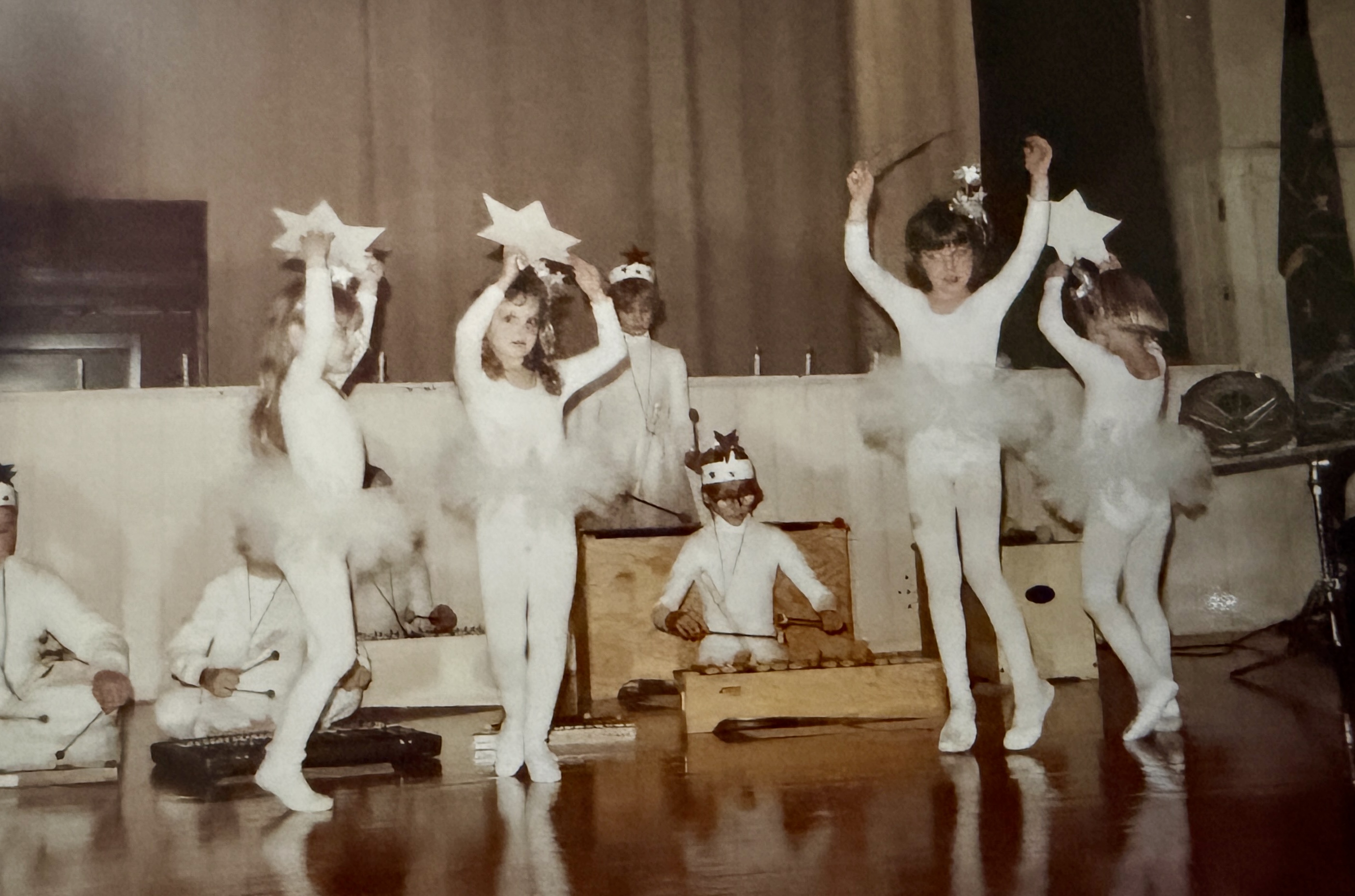
The Midwest School of Performing Arts (or Midwest, for short) was a preschool and kindergarten for the strange and unusual. Well, that wasn’t their positioning statement, but based on my experience, Midwest was a place where the strange and unusual thrived.
Midwest’s differentiator was in its creativity. It was run by two women named Meg and Sally, whose house was attached to the back of the school, and who believed that kids, when given the right environment, would thrive creatively through music, dance, and art.
Boy oh boy, was this the place for me.
Midwest is where I learned to play the piano and the recorder, where I had endless tap dance recitals, where we played and played and played and played. Half of my photo album includes photos from this period of my life. It’s where I learned to swim (begrudgingly - Meg pushed my head in the water and said “down you go!”), where I learned that I could make things with my hands, and where I learned to be courteous and respectful. One day I came to school and the entire inside of the building had been turned into a tumbling and gymnastics room. On another day it might have long tables with tablecloths and paint, waiting for our little hands to start exploring.
Everything I needed to know I learned in kindergarten.
When you’re 4 or 5, life is all about exploration. Your entire existence is about opening your eyes, experiencing the world, learning to move your body, and connecting with the world around you. What better way to do that than through music, dance and art?
Back in 1992, there was no technology in the classroom. No ParentSquare, no Tadpole apps existed. But you know what we had instead? The same fundamental learning that informed every kid who came before me.
Technology can make us think that we are growing and scaling and learning faster and faster. But it can also feel like traveling without moving. You can put a smart whiteboard into a classroom, but it functions nearly the same as an overhead projector. What makes both pieces of hardware matter is what you write on it.
Robert Fulghum’s book was written to illustrate this point. “Remember the little seed in the Styrofoam cup: The roots go down and the plant goes up, and nobody really knows how or why, but we are all like that.” Seed germination is an exercise that has stood the test of time because it so perfectly illustrates how things grow. We watched caterpillars turn into butterflies to experience transformation - and then we get older and apply that phrase to moments in our lives where we’ve transformed.
I reflect on this for two reasons. I was blessed with an amazing educational system that truly benefitted me. I think about it often, not just when driving around in Terre Haute. These experiences made me who I am and I am so freaking thankful for them. I love being strange and unusual and I love that I have such vivid memories of such a special time in my life.
But moreso I reflect on kindergarten because Robert’s right. The fundamentals are all there. The Golden Rule, wash your hands before you eat, put things back where you found them… these fundamentals haven’t gone away.
And guess what? The same is true in business. We have overcomplicated what it means to make and sell a product or service. It doesn’t matter that we have the internet now or all of these apps. The same fundamentals exist and will always exist.
Marketing has seen this effect several times over. Just in my two decade career I’ve witnessed a dozen new channels exist that weren’t around in Mad Men times. Google search and display ads, SEO, social media, email marketing, SMS, YouTube - Don Draper wasn’t thinking about this. And yet his job would be the exact same today as it was then.
The proliferation of marketing channels has gotten confused with human attention and behavioral psychology. Biologically speaking, our brains are the same brains they were when we were cavemen. Whether we like it or not, we have an ego, we still have fight or flight responses, and the survival of the fittest still reigns true. Technology opened up several new ways to put your ad in front of your prospect. But that prospect is still the same human they were 10,000 years ago.
Marketing software - and the people who create it - want you to believe you can create a perfect attribution system that determines exactly when your buyer is going to buy from you and exactly what channels to use to reach them and when. They can map the entire buyer journey so you know exactly where to spend your money and know exactly what you’re going to get from it.
This is just not true.
You don’t need me to explain it. Think about the last purchase you made. Can you actually trace back how you got to the checkout? How many times did you encounter the product before you bought it? Did a friend refer it or did you see an Instagram ad? You may not even remember - because our brains are really bad at putting these details together. Seasoned marketers hate the “Tell us how you heard about us” multi-choice question because the data is practically pointless. Not only are humans bad at remembering this information, but which touchpoint are they going to tell you about? The first time they heard about your product? The last? It takes anywhere between 7 to 14 times for your product to be seen before someone actually makes a purchase, and the higher the price, the longer the runway.
Our biology is our foundation. 1950’s moms have the same heartstrings as moms of the 2000’s. Business owners feel the same weight of responsibility today as they did in the past. Those feelings are what marketing should be focused on - then and only then should we determine what channels to use to share said message.
Remember: Marketing is one part great design, one part behavioral psychology, and one part strategy. The signals you need are already there. You just need to look at the people more, and less at the tools and technologies in their pocket.

New: EventReps conference lead-capture partnership
Read →