On this page

Positioning & Messaging
When Who You Were Is No Longer Who You Are
The most important positioning work isn't at launch. It's when a growing company has to redefine itself. And the stakes are higher than most founders realize.
"You've nailed it. This is it. I'm ready to take this and run with the new direction right now."
I live for that moment. Eyes wide, the corners of their mouth turned up into a smile. The clouds part. Everything clicks. A founder or CEO who has been carrying the weight of a narrative that no longer fits their company finally has the solid direction they needed to move forward. It's a sigh of relief that only research, experience, and honest diagnosis can create.
I've had the pleasure of experiencing this with a handful of founders and CEOs now. Helping a leader set the direction for the next 18 to 24 months (or more) of their company is one of the most satisfying things I do. It's where I feel like I'm actually helping.
What gets us to that moment is positioning work. Not the founding kind, where you're naming something new and deciding how to introduce it to the world. The harder kind: when a company that already exists has to decide who it's becoming next.
The three moments that make repositioning necessary
Most founders think about positioning once: at the start, when they're explaining what they built for the first time. What they don't expect is that they'll have to do it again. And the second time is harder.
There are three inflection points that bring a company to a repositioning moment.
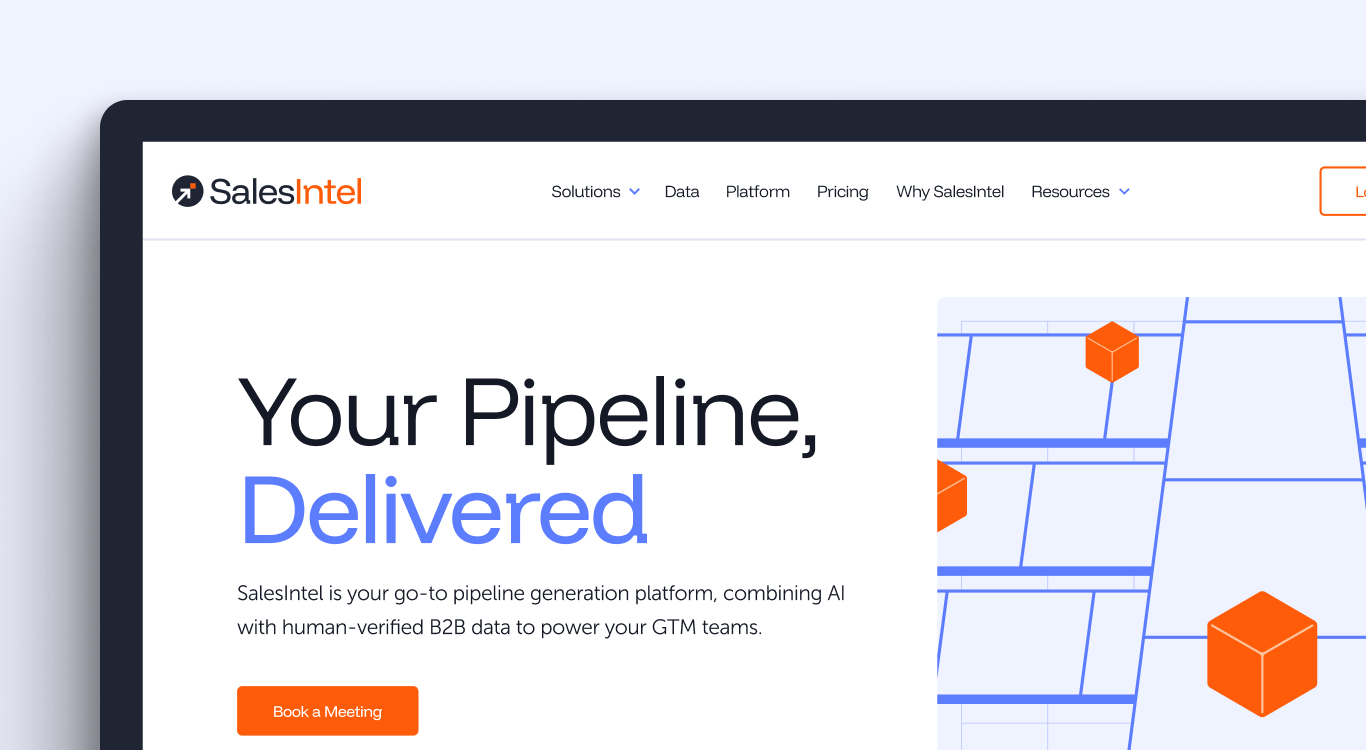
The product outgrew the narrative. This is SalesIntel's story. Manoj Ramnani built a contact database that sales teams loved. Then he kept building. AI-enriched data. Tools for marketers. Solutions for RevOps leaders. The product evolved into something meaningfully different — a pipeline generation platform — but the market still knew SalesIntel as a contact data tool. The story hadn't caught up to the product. When we came in, the website listed every product and feature in a single undifferentiated list with no architecture to help a buyer understand what was built for them. The positioning wasn't wrong. It was just old, and didn’t reflect what the company was about to become.
The narrative obscured the real value. This is Health Cost IQ's story. The product wasn't just useful. It was genuinely powerful. Fathom AI, their proprietary technology, was capable of predicting healthcare outcomes in ways that could change lives. But the company had been telling a cost savings story. Not because it was false, but because cost savings is the ultimate outcome. It just isn’t the ultimate value. The result was a product positioned as a point solution when it was actually a platform, and a story that led with dollars saved when it should have led with lives changed. The market couldn't see what the technology was actually capable of because the narrative kept directing them to look somewhere else.
Growth stalled and nobody could explain why. This is the situation facing our newest client, [CLIENT NAME], who we're in the middle of working with now. I can’t say too much just yet, but what I can tell you is this: they reached a real revenue milestone without ever fully defining who the product was for. When you grow without a clear ICP, the product gets shaped by whoever happened to buy it. Features accumulate without coherent logic. Eventually the product becomes difficult to describe, the sales motion becomes inconsistent, and growth plateaus. Not because the market disappeared. Because the company never decided who it was really for.
All three of these moments have something in common: the company is at a crossroads. They can stay where they are and watch the gap widen, or they can do the hard work of deciding who they're becoming.
Why repositioning is harder than founding positioning
When you're starting from scratch, positioning is difficult in the way that blank canvases are difficult. Unlimited options, no constraints. Uncomfortable, but clean.
Repositioning is different. You're not working on a blank canvas. You're painting over something that already exists. And that existing thing has weight: customers who know you a certain way, a sales team with ingrained messaging, a website that says the old thing, a category the market has already filed you into.
The risk isn't just getting the new position wrong. It's the cost of being misaligned across every function while you're in the middle of the transition. Your sales team is pitching one story. Your product is building toward another. Your marketing is somewhere in between. Prospects are confused because none of it adds up.
This is the B-to-C problem. Getting from A to B, the initial launch and founding positioning, is hard, but it's a known kind of hard. Founders expect it. Getting from B to C requires something different: the ability to look at what you've built, understand what it's actually become, and make a decisive call about where it goes next.
Which is why it matters who does the work.
What positioning actually touches, and why that scope matters
Founders sometimes come to this work thinking they need a new tagline. Or a refreshed website. Or cleaner messaging for the sales deck.
Those are outputs. Positioning is what determines whether any of those outputs are pointing in the right direction.
Done correctly, positioning is the foundation that directs every discipline in the company. It tells product what to build next and what to deprioritize. It tells sales who to target and what story to tell. It tells marketing what category to compete in and what differentiators to amplify. It tells talent what kind of people the company needs to become the thing it's trying to become.
This is why positioning work at the growth stage cannot be handed to a junior hire or generated by AI. Not because those tools lack intelligence. Because they lack the cross-functional judgment that comes from having seen what happens when product, sales, marketing, and customer success are misaligned. And they lack the ability to make the taste-based decisions about which direction is right, not just which directions are possible.
April Dunford, whose book Obviously Awesome is required reading for anyone serious about this topic, talks about positioning as a set of deliberate choices about context. Making the right choice requires knowing what the wrong choices look like in practice. That knowledge comes from experience, and April has a lot of it.
What Christian and I bring to this work is the ability to look at a company across all of its functions at once. My background is in marketing. Christian's is in product and design. We've both led sales. When we sit down to think about repositioning a company, we're not looking at it through one lens. We're looking at the product and asking whether it's packaged in a way that reflects its real value. We're looking at the sales motion and asking what it's winning and consistently losing, and why. We're looking at the marketing message and asking whether it matches what customers actually buy the product for. Because those two things are often different.
What the work actually looks like
The first thing I always ask a founder is: why are you doing this?
That sounds simple. But of course, it's not. The reason for positioning determines the success metric. A company trying to get acquired needs to signal something very specific to a potential buyer. A company trying to expand from one product line to a platform needs to build a narrative that makes the expansion feel inevitable, not arbitrary. A company stalled at $10M that can see a path to $50M needs a position that reflects the market it's going after, not the market it came from. Without a clear answer to that question, there's nothing to measure the work against.
From there, the process is intentionally non-linear. Founders sometimes expect a clean sequence of deliverables. What actually happens in the first two weeks looks more like a diagnostic. I'm asking about the product: what features exist, how customers are actually using it, and whether the outcomes they're experiencing match the outcomes the company thinks it's delivering. I'm asking about sales: what deals do you win, what do you consistently lose, and why? I'm asking about marketing: what's the main message, and does it reflect what buyers are actually purchasing? I'm asking about pricing: where is the company leaving money on the table? I'm asking about team: do you have the right people in the right roles to execute on the direction you want to go?
It's like a hospital intake. You come in with stomach pain. The doctor doesn't immediately treat the stomach. They ask about your history, your habits, recent injuries, other symptoms. Because stomach pain could be ten different things, and the wrong diagnosis is worse than no diagnosis. That's what the first phase of positioning work actually is.
Once I have that picture, I take my findings back to the founder and test them. I've done this work quickly, from the outside. They've lived it for years. The conversation that follows, where they push back or confirm what I've found, is often where the real clarity starts to form.
From there, I can identify the actual options. Not just messaging directions, but market category options. Competitive angles. Product packaging structures. The areas where the company's real strengths aren't being used to their advantage. We lay out a few directions, present them, and the founder makes the call.
For SalesIntel, that meant restructuring the entire product suite around three buyer personas — sales, marketing, and RevOps — and building a new market position around pipeline generation rather than contact data. The new architecture made it immediately clear to any prospect what was built for them, and why SalesIntel was a platform, not a point solution.
For Health Cost IQ, it meant elevating the story from cost savings to enriched intelligence that predicts what matters most. It meant repackaging the product into three distinct modules organized by how buyers actually purchase and use the technology. And it meant rebuilding the brand to match, because a story that ambitious needed a visual identity that could carry it.
What comes after the positioning decision
This is the part founders get excited about. Because once the direction is set, everything becomes actionable.
The positioning decision is the foundation. What gets built on top of it is a new brand that accurately reflects the new category. New messaging and narrative that backs up the new claim and focus. A product hierarchy that organizes what was previously scattered into something a buyer can understand. A website that marketing can run campaigns on and sales can actually use.
That sequence matters. Brand, messaging, product hierarchy, website: in that order, each one building on the last. And each one is only as strong as the positioning underneath it.
The moment those pieces come together is the one I described at the top. Eyes wide. Corners of the mouth turned up. The clouds part.
That's what it feels like when a company finally looks like what it actually is.