On this page

Marketing Strategy
The Right Stack for an Early Stage Startup Website
Most founders default to whatever they've heard of or whatever feels familiar. Here's how to choose a website platform when you're early stage, non-technical, and need to move fast without building something you'll regret.
I used WordPress for most of my career. Up until about two years ago, I still considered it a legitimate recommendation for early stage startups. It's been around forever. It powers 43% of the internet. If you're a founder who has heard "WordPress is the gold standard," you've heard this from someone who means well.
But I've changed my mind. And if you're building a startup website right now, I think you should too.
Here's the thing about something being around forever: longevity signals durability, not necessarily fit. WordPress has lasted because it's genuinely powerful at what it does. But what it does is built for a team size and technical infrastructure that most early stage startups don't have and shouldn't need.
We're at a moment where Claude can design a website in minutes and deploy it to Webflow without a single line of code written by a human.
Read that line again.
With the Claude-Webflow MCP integration that launched in February 2026, you can manage bulk CMS updates, run SEO audits, and make structural changes to your site directly from a conversation. That's a remarkable shift. And I’m about to explain why.
If you're about to choose a platform for your startup website, or you're stuck on one that isn't working for your team, this article is the practical breakdown you need.
Why WordPress isn't built for where you are right now
Let me be clear about what WordPress is actually good at. It's an excellent platform for content-heavy sites and large editorial operations. It runs serious publications and complex e-commerce operations. For those use cases, it makes sense.
For an early stage startup with one or two people touching the website? It's a semi truck when you need a Subaru.
Founders who say "WordPress is the gold standard" usually mean one thing: it's been around forever, which signals it must be solid. Longevity signals durability. It does not signal fit.
As a startup, you need two kinds of speed:
- Speed for your buyer, meaning your site loads fast enough for them to find the “book a demo” button.
- Speed for your team, meaning you can actually build and update the thing without waiting on someone else.
WordPress creates friction against both.
On load speed: WordPress is a database-driven platform built on PHP. When someone visits your page, WordPress has to query its database, compile the page, and serve it. Every time. To get around this, sites run caching plugins that store pre-built versions of pages so they don't have to be regenerated from scratch on each request. That works, but it requires a plugin to configure, a developer to set up correctly, and ongoing cache management any time you update content. Sounds like a lot of work that isn’t about building and selling your product.
On team speed: the WordPress modernization story is that tools like Divi and Elementor gave non-developers a visual way to edit. And they did, somewhat. But Divi is a skin on top of WordPress, not a replacement for its underlying architecture. Getting a WordPress site stood up still requires a developer. Getting it editable by a non-technical marketer requires a second layer of dev work: build the site, then build a structured editing environment so your team can touch it without accidentally breaking something. Two development phases to accomplish what should be one. Meanwhile, your developer would rather be building your product. That's what they're actually there for. Pulling them onto a website ticket is a morale problem dressed up as a project management problem.
We signed a new client recently who had designed a landing page for one of their services. That was two months ago. The page still hadn't been built. The team couldn't market the service, couldn't drive traffic to it, couldn't capture a single lead from it, because the landing page existed only as a design file waiting in a developer's queue. We wrote about this in our last article. Think about what two months of missed search traffic costs a startup that's still trying to find its first hundred customers..
Marketers are becoming more full-stack. We're learning design tools, building with AI, and shipping things that used to require engineering support. WordPress hasn't kept up with this shift. There's no Claude MCP for WordPress. There has been very little meaningful product innovation from the platform in recent years. It is, in the bluntest terms, riding its own market awareness while the market moves on.
Where the other platforms actually fit
Before making the case for Webflow, it's worth being honest about the full landscape. Not every startup has the same situation, and not every platform deserves the same answer.
Squarespace
- What it is: A polished, all-in-one website builder. Hosting, SSL, and basic analytics included. Templates look good out of the box.
- What it's good at: Simple sites with low update cadence. We built TechPoint Youth's website on Squarespace. They're a small nonprofit team that doesn't launch new programs constantly and doesn't need to publish content regularly. They can get in and make basic updates on their own without us. For that use case, Squarespace is great.
- Where it falls short for startups: You will outgrow it. Startups add services, publish content, build case studies, and update messaging constantly as they learn more about their market. That cadence will push past Squarespace's limits within three to six months. At that point you're either stuck with a stale site or you're replatforming. Starting on Webflow skips that migration entirely.
- Verdict: Right for simple organizations with stable content needs. Not the right foundation for a startup that's still figuring out its market.
Wix
- What it is: An all-in-one website platform built for small businesses, entrepreneurs, and consumer-facing brands.
- What it's good at: Getting something live quickly without much technical background. More flexible than Squarespace, easier to start with than Webflow.
- Where it falls short for startups: The design ceiling. Code cleanliness, visual distinctiveness, and the ability to build something your buyer will actually remember are all constrained by the platform. It's a tool for looking presentable. It's not a foundation for a brand that needs to stand out. (And as we wrote in Your Website Has More Work to Do Now, Not Less, standing out is not optional.)
- Verdict: Reasonable for small businesses and portfolios. For a B2B startup where brand differentiation matters, you'll hit the ceiling before you're ready.
Framer
- What it is: A design-forward builder popular among designers for its ability to prototype quickly and produce interactive, animation-heavy sites.
- What it's good at: Speed of prototyping. If you want something visually dynamic live fast, Framer makes it easy. We considered building on it ourselves before landing on Webflow.
- Where it falls short for startups: The CMS. For a B2B SaaS startup, you need to publish content, create case studies, and build out a resource library. That work is done by marketers who need to get in and publish without friction. Framer's editorial experience isn't built for that.
- Verdict: Worth watching, especially for design-forward teams. Not the default recommendation for a B2B startup that needs a content-driven site its marketing team can actually manage.
Why Webflow is the right stack for most early stage B2B startups
Webflow generates clean, semantic HTML and CSS. It is production-quality code. Independent benchmarks consistently put Webflow-built sites among the top performers on PageSpeed Insights, without the plugin overhead that makes WordPress performance a constant management project.
But the more important argument for an early stage startup is organizational.
A designer who knows Webflow can build and ship without a developer. A marketer can update copy, swap out sections, and publish new pages without filing a ticket. The founder can make changes without breaking anything. Webflow creates components that non-technical people can actually use. Get in, update a section, publish it, without touching code or accidentally dismantling something else. On a hardcoded WordPress site, that requires a developer to build a custom editing environment first. Two development phases to accomplish what Webflow does by default.
This is why my thinking on the first marketing hire has shifted. I used to hire a designer and plan to eventually add dedicated web development talent. Today, I'd hire a designer with Webflow experience or the appetite to learn it. Design and build happen in the same tool. One hire doing the work of two.
Webflow is also where the AI integration is happening right now. The official Claude connector launched in February 2026, connecting Claude directly to Webflow's Designer and Data APIs via MCP. From a conversation in Claude, you can manage CMS content, run SEO audits, update styles, and create pages. Now, there’s still a fair amount of manual work to do. But nothing at all like starting from scratch.
And for most early stage startups, HubSpot is the starter CRM. Webflow connects to it natively, directly from the Designer. Form submissions route straight into HubSpot. Previously, even this task took a team: a marketer to build the form, a developer to insert it, and a designer to make it match the brand style. Not now.
The platform is also paying attention to where the market is going. Webflow Cloud launched in May 2025, real-time collaboration followed in late 2025, and their 2025 conference unveiled AI-powered SEO tools and app generation. That matters when you're picking a platform you plan to be on for the next two to three years.
TLDR: Webflow has a learning curve. You can't launch something in an afternoon with zero design background. A custom Webflow build done well has a real cost. But for a startup investing in design quality, that's a brand investment worth taking.
Case study: Illume
Illume came to Five Four with an AI-generated website. Honestly, it wasn't bad-looking. It was minimal, clean, and focused. However, it said nothing distinctive about who they were or who they served (or enough about the product to make you want a demo).
We rebuilt the brand from scratch and designed and built the new site entirely on Webflow. The founder was not involved in the build. It was us, Claude, and Webflow.
The build took five business days.
The old way, on a traditional platform with a standard development workflow, would have taken a month.
On launch day, with PR going out simultaneously, Illume received two qualified pipeline opportunities through the contact form. Those submissions routed directly into HubSpot through the native integration we had configured. The site went live, the pipeline started, and the founder didn't have to touch a single thing to make it work!
That's what the right stack looks like. Fast to build, easy to maintain, and connected to the tools you already uses. And distinctive enough that buyers actually remember it.
How these platforms actually compare
Here's the breakdown across the dimensions that matter most for an early stage B2B startup:
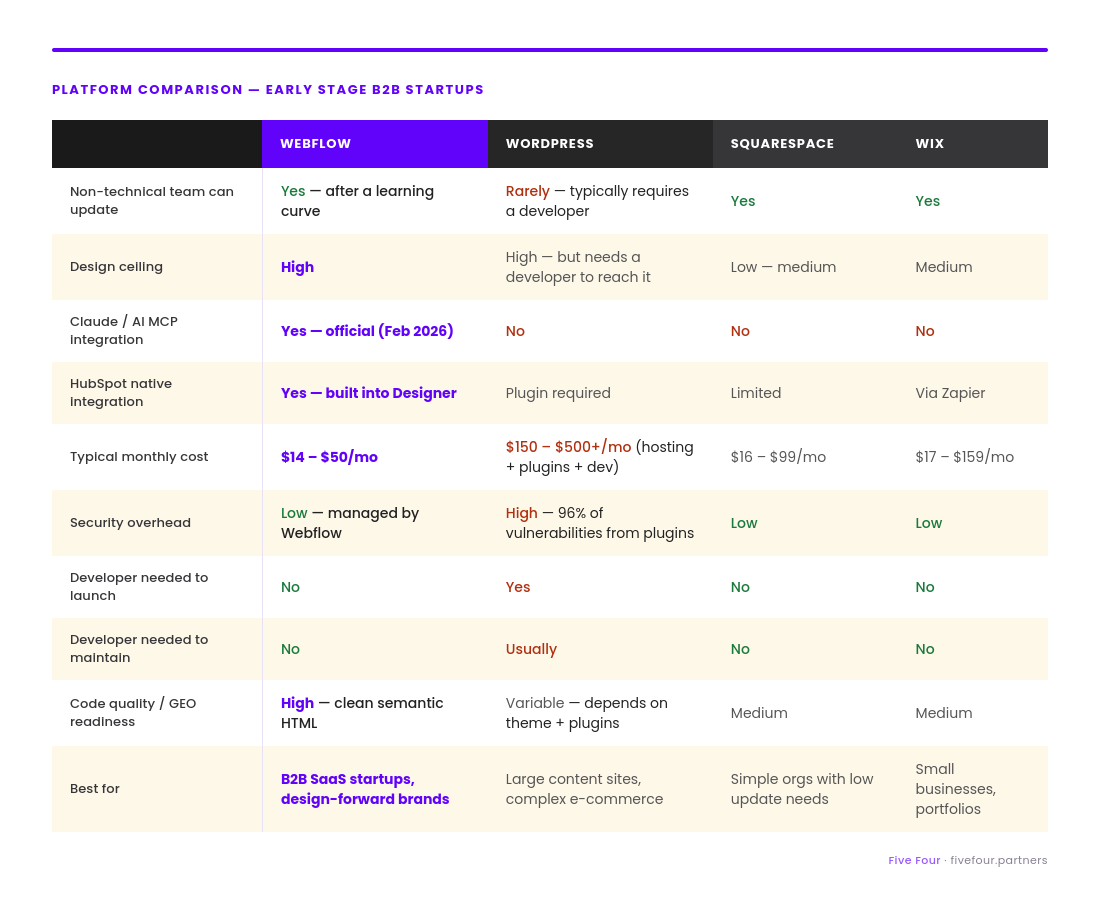
The total cost of ownership difference is real and worth flagging separately. WordPress looks cheap to start. Once you add managed hosting, a caching plugin, a security plugin, a page builder, and occasional developer time, you're at multiples of what Webflow or Squarespace cost. For a startup watching every dollar, that math matters.
The one thing that no platform solves for you
Worth saying clearly: none of this matters if you build on the right platform with the wrong strategy.
A well-designed Webflow site with bad messaging doesn't convert. A fast, clean, AI-ready site that says nothing distinctive about your product is still an expensive nothing. The platform is infrastructure. What you put on it, and whether it actually communicates who you are and what you do for whom, is a separate problem.
We wrote about that problem in Your Website Has More Work to Do Now, Not Less. If you haven't read it, start there. Then come back here and pick your platform like you choose your fighter.
The stack should be invisible when it's working. Pick one that lets your team move without bottlenecks, lets your designers build something your buyer will actually remember, and doesn't require a developer every time someone wants to change a headline.
For most early stage B2B startups, that's Webflow. And right now, with the Claude integration live, there's never been a better time to get on it.