On this page

Marketing Strategy
Bot Traffic and Other Things Skewing Your Website Numbers
Bots, form spam, double-counted conversions, and vanity traffic can inflate your numbers before a redesign. Here's how to clean them up first.
To make the transition successful, you have to know your current numbers so you have a baseline going forward. It's the one big dataset an existing company has that a new company doesn't.
That means sorting through your metrics: your search traffic, your top pages, your conversions, and everything else I covered in website redesign SEO.
The pitfall is that the data you have is often misleading. A lot of things can skew your numbers.
Bots make your site look bigger than it is
A lot of people don't filter bot traffic out of their analytics, so they get inflated results that make their site look bigger than it is. Bots fill out forms too, but that's more obvious. Bots give us a false sense of confidence in our site traffic. Filter them out, and the numbers change.
This happens to us too. From July 6 to November 15, 52% of the sessions on our own website (2,793 of 5,423) came from bots in Singapore and China, and almost none of them stayed long enough to count as engaged. In the first week of November, bots were 88% of our traffic. If we hadn't filtered them out, that would have looked like our best week ever.
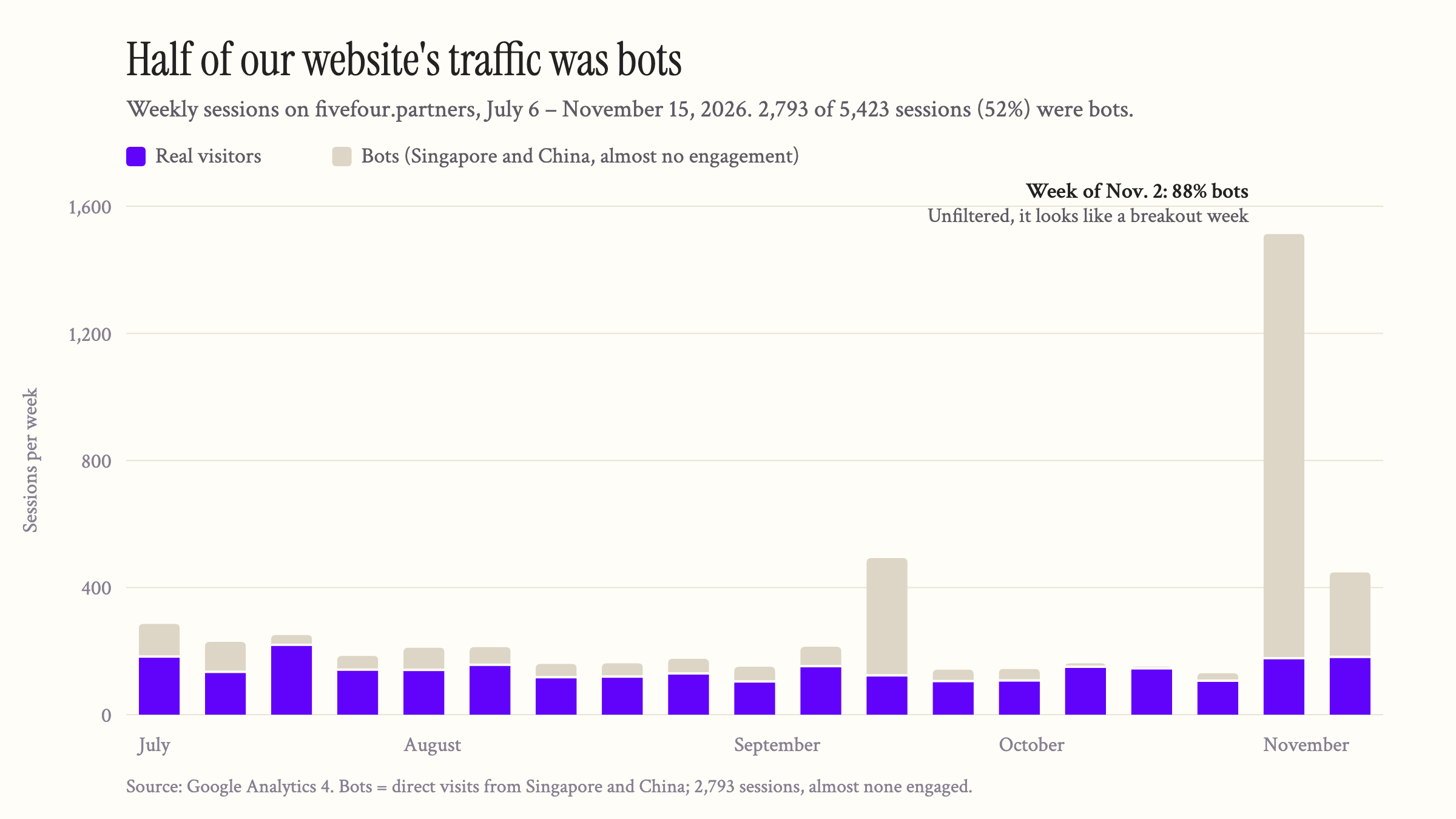
We've seen the same thing with our clients. One B2B services firm had a week where about 40% of its traffic was bots. Another SaaS client estimated 60–70% of its old traffic was bots, so when sessions dropped 56% after we relaunched the site, most of what went away was bots, not prospects and customers.
Forms are where the picture can really get weird. That same SaaS client's "demo requests" from December to May were mostly fake. Of those, 348 came from the Netherlands and 165 from Russia, compared with 127 from the U.S., where their prospects are. All of them were dealt with appropriately in their CRM, but when you're pulling numbers as baselines, it's easy to forget the reality.
Getting focused will shrink your traffic
We've also found clients getting traffic from areas outside their target market, especially companies selling a physical product that doesn't ship in certain markets. In these cases, the traffic can be "real," but it still inflates the results you may actually care about: leads. Moreover, if you reposition and get more focused, you'll see less site traffic, because you'll lose the out-of-market visitors. All positive things but numerically counterintuitive.
At Five Four, we cut our geography down to the U.S. for Google Ads. Before that, about 1 in 5 of our ad clicks came from outside the U.S. In August and September, those clicks cost us about $150, and not one of them turned into a lead.
Fixing your tracking will make your numbers look worse
We've had clients whose analytics counted form submissions twice because they were set up incorrectly, and sometimes Google Ads imports those same events. Look, this may seem too obvious to be true, but I've seen it happen a couple times this past year.
That same SaaS client had its "demo request" event firing on every form on the site, including contact, support, onboarding, and even their customer help center. Once we fixed that, it still fired any time someone loaded the thank-you page directly, which spammers did FREQUENTLY. So their lead count was counting every support and contact form, plus a bunch of thank-you page visits where nobody filled anything out. And Google Ads was optimizing toward that same number the whole time (which means they were likely paying for ads that brought their own customers back to their site!).
Their help center also reported into the same Google Analytics as the marketing site, so support visits were counted as website traffic until we filtered them out. With another client, their staging site reported into the same analytics as the live site, so every time they previewed their staged build, it counted as a visit!
Cleaning all of this up can make your numbers look a lot worse than you thought. First the bots come out, then the double-counted events. That's why it helps to apply the same cleanup to your past data, so you're comparing apples to apples. Again, these are all quite simple things in isolation but en masse create artificially high baselines.
Vanity traffic doesn't add to your bottom line
This is a play on vanity metrics: traffic that looks great but isn't always useful. Think about LinkedIn. A lot of people post selfies because they perform better, but that doesn't mean they create more value. Nobody buys your services because you put a selfie in the post. Personal posts do well too, and if you're a company posting about your team's culture, you'll probably get a lot more traffic from those. But it doesn't add to your bottom line.
The same thing happens on your website. There's nothing wrong with traffic to your About and Careers pages from people who want to learn about you. That's great in the long run. But it needs to be measured separately when you're optimizing a site rebuild. You may lose a lot of that vanity traffic as your site gets more focused, just like you lose traffic from geographies you don't sell to.
So, what can you do about this? Clean your numbers before you compare
- Filter bot traffic: exclude countries you don't sell to that show zero engagement.
- Check form submissions by country, and block spam before it's imported into your CRM.
- Make sure each conversion fires only once, and that Google Ads imports the same events.
- Separate traffic that isn't your marketing site, like a help center, an app, or a staging site.
- Report About, Careers, and culture traffic separately from the pages that are targeted toward marketing and sales.
- Apply every filter to your past data too, so before and after are measured the same way.
Before any redesign project starts, whether you're the founder starting it or you're handing it off to a team, I'd first make sure you're pulling data and analytics filtered to the stuff that matters. Once you make changes, it can be harder to get the analytics you want for the past. Those filtered numbers are also a much more reasonable goal than ridiculously high standards that will only disappoint you after your redesign goes live. Being diligent in your prep will help you make better decisions on marketing later.